RSA asymmetric encryption
1. Symmetric and asymmetric encryption in brief
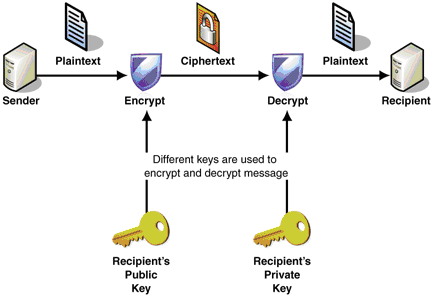
Almost anyone who has dipped a toe into information security has heard of the two common families: symmetric cryptography and asymmetric cryptography. In essence:
-
Symmetric encryption (also called secret-key encryption): you use the same key to lock and unlock the data you want to keep secret. Whoever sends and whoever receives both need that key.
-
Asymmetric encryption (also called public-key encryption): you use two different keys to lock and unlock confidential data. The
public keyis published and sent to whoever needs to encrypt for you; theprivate keystays secret and acts like a master key that can open everything that was locked with the matching public key.
2. Why do we need asymmetric encryption?
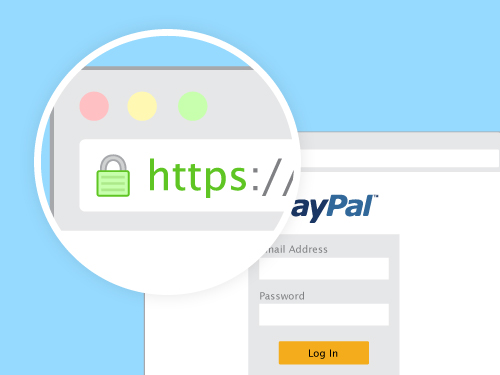
In short, most apps you use every day—Facebook, Gmail, Amazon, PayPal, and so on—rely on HTTPS. HTTPS is “safer” than HTTP because traffic between the client and the server is protected by SSL/TLS, which uses both symmetric and asymmetric cryptography. That is how we can keep sensitive transactions on the Internet from having their contents stolen in transit. Frankly, without cryptography—and asymmetric encryption in particular—there would be no e-commerce.
Plain HTTP sends data as plain text: if someone eavesdrops on what you exchange with the server, they can read and tamper with it (a man-in-the-middle attack). Even if you used symmetric encryption for the traffic, you still have a weak spot: the two sides must exchange a key before they can encrypt and decrypt, and an attacker can still snatch that key and read the traffic.
Asymmetric encryption fixes that weakness. The idea: instead of sending a key to the client, the server sends a lock. The client locks the secret message in a box; only the server can decrypt it. So clients cannot read each other’s messages—only the server, with the private key, can open those boxes. (In practice the public key is used both to encrypt and to verify data sent to and from the server!)
3. RSA
RSA is one of the most widely used asymmetric schemes. It is named after three MIT researchers who designed it: Ron Rivest, Adi Shamir, and Leonard Adleman. The security of RSA hinges on the fact that factoring a very large number into two primes is hard. (If (a \times b = c), recovering (a) and (b) from (c) is integer factorization.)
The RSA workflow has four stages: key generation, key distribution, encryption, and decryption. To keep things secret, each deployment generates its own public and private keys. After the handshake and once the public key reaches the client, the channel is actually encrypted when server and client talk.
4. Encryption and decryption
Skipping for a moment how the keys are produced, the encrypt/decrypt formulas are:
- Encryption: $$m^e \mod n = c$$
- Decryption: $$c^d \mod n = m$$
Where:
- (m) is the original message
- (e) and (n) form the public key
- (c) is the ciphertext
- (d) is the private key—usually a huge number, guarded absolutely
Example with (e = 17), (n = 3233), (d = 2753), and message (m = 42):
- Encrypt: $$42^{17} \mod 3233 = 2557$$
Decrypting (2557) brings you back to (42):
- Decrypt: $$2557^{2753} \mod 3233 = 42$$
The private key (d) is derived from the two prime factors of (n). In production, (n) is the product of two large primes (e.g. 2048-bit), so computing (d) from (p) and (q) is easy, but recovering (p) and (q) from (n) to steal the private key is practically infeasible with today’s hardware.
5. Generating the public and private keys
This part is math-heavy; you can ignore most of it if you use built-in cipher APIs in Java or JavaScript.
- Pick two distinct random primes (p) and (q) (in practice, the bigger the better—2048 bits, on the order of 617 decimal digits).
- Example: (p = 61) and (q = 53)
- Compute the product $$n = p \times q = 61 \times 53 = 3233$$
- Compute Euler’s totient: $$\Phi(n) = (p − 1)(q − 1)$$ $$\Phi(3233) = (61 - 1) \times (53 - 1) = 3120$$
- Choose some (e) with $$1 < e < 3120$$ that is coprime to (3120).
- Take $$e = 17$$
- Compute (d) as the modular multiplicative inverse of (e \bmod \Phi(n)):
$$ \ e \times d \mod \Phi(n) = 1 \ 17 \times d \mod 3120 = 1 $$
You can brute-force (d) (feasible here because the numbers are tiny), or use the extended Euclidean algorithm; you get $$d = 2753$$
Brute force looks like this (fewer than 15 iterations):
def compute_d(phi_n, e):
	for i in range(1, 1000):
		x = ((i * phi_n) + 1) / e
		y = (e * x) % phi_n
		if y == 1:
			print(x)
			break

compute_d(3120, 17)
So we end up with public key (e = 17), (n = 3233) and private key (d = 2753).
6. How secure is RSA?
RSA’s strength depends heavily on the random number generator that produces the initial primes (p) and (q). Recovering (p) and (q) from (n) is essentially impossible for 2048-bit primes as described—but computing (d) from (p) and (q) is easy. So if anyone guesses or breaks the RNG, consider RSA broken. There has been reporting that the U.S. National Security Agency (NSA) slipped a back door into the Dual Elliptic Curve random-number generator so RSA could be cracked perhaps 10,000× faster. Notably, that generator was shipped as the default by RSA the company (founded by the three authors of the RSA system) in many products. (Exclusive: NSA infiltrated RSA security more deeply than thought - study)
References
- Thái DN, Modern cryptography (1) (Vietnamese series), http://vnhacker.blogspot.fi/2010/05/mat-ma-hien-ai-1.html
- Encryption Huge Number, Numberphile, https://www.youtube.com/watch?v=M7kEpw1tn50